

Quality Management System - AQL methodology page

Applied Standard
ISO 2859
Defect Categories
3 Levels
Common AQL Value
2.5
Critical Defect AQL
0
ERP Integration
Fully Integrated with All ERP Systems
Quality control, production, inventory, shipment and reporting processes can be integrated to work seamlessly with your existing ERP infrastructure. This allows AQL inspection results, batch information and accept/reject decisions to be transferred directly into your current business workflows without interruption.
Defect Categories and AQL Levels
Critical Defect
AQL = 0
Safety or compliance failure. Zero tolerance. A single defect rejects the entire batch.
Major Defect
AQL = 2.5
Significantly affects product function or appearance; likely to cause customer returns.
Minor Defect
AQL = 4.0
Small cosmetic imperfections. Does not affect product function; wider acceptance threshold.
Table A — Lot Size to Code Letter
Find your shipment quantity and inspection level to determine your AQL code letter. Take that letter to Table B.
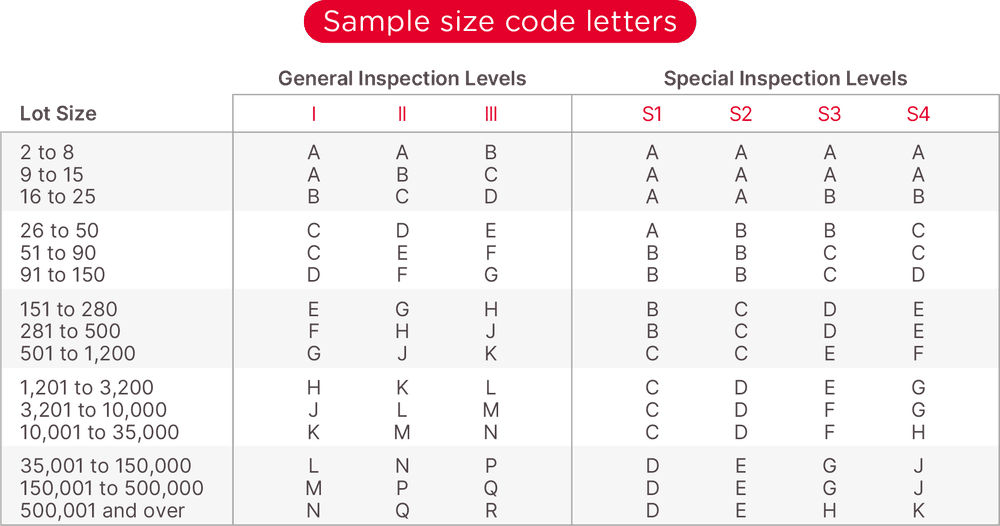
* Source: ANSI/ASQ Z1.4 – 2008
Table B — Sample Size and Accept/Reject Points
Use the code letter from Table A to find how many units to inspect and the defect thresholds for acceptance or rejection.
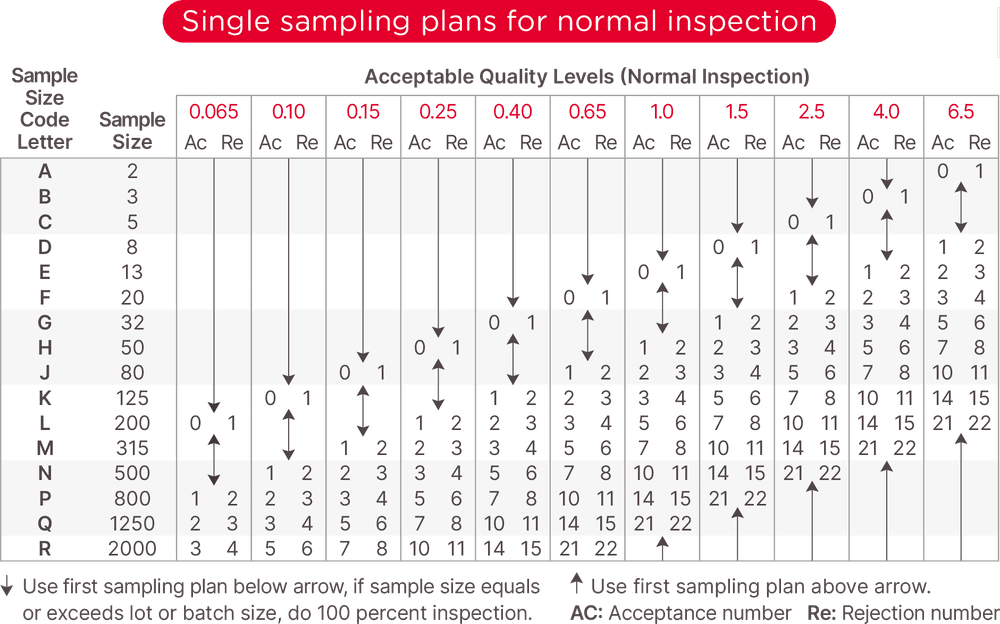
* Source: ANSI/ASQ Z1.4 – 2008
Example Scenario
Shipment of 4,000 face masks — General Inspection Level II, AQL 2.5
Lot size
4,000
Code letter (Table A)
L
Sample size
200 units
Accept threshold
≤ 10 defects
Reject threshold
≥ 11 defects
Inspection Process
Define the lot size
Determine the total shipment quantity and choose the inspection level (I, II, or III).
Find the code letter using Table A
Cross-reference lot size and inspection level to get the corresponding code letter.
Determine sample size and thresholds using Table B
Use the code letter and AQL value to find how many units to inspect and the accept/reject points.
Accept or reject the batch
If defects are below the threshold, the batch is accepted. If above, it is rejected and a corrective action report is issued.